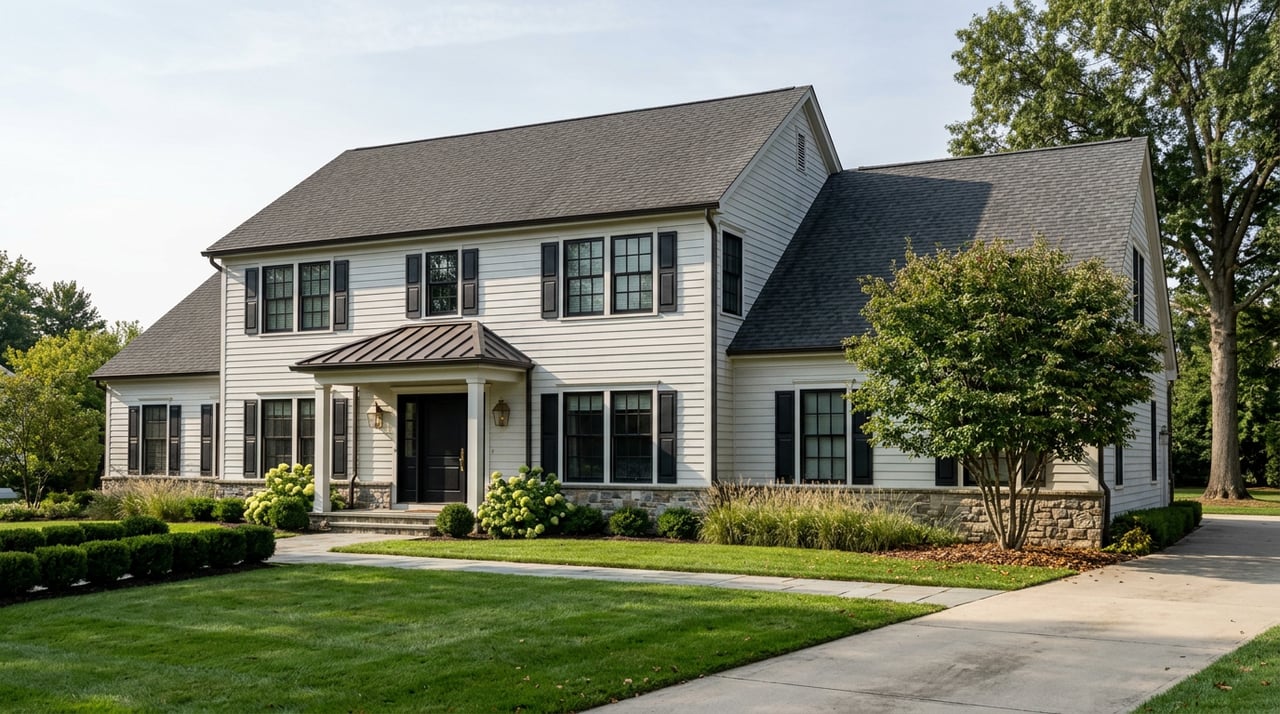
If you've spent any time on a real estate portal searching Mercer County, you've seen a countywide number. It reads like a single, coherent market. That number doesn't tell you what a listing looks like across the county.
It isn't a market. It's an average of at least four markets that behave nothing alike, and the gap between them is wide enough that anchoring your search to that countywide figure will send you looking in the wrong towns entirely.
The County Number Everyone Quotes
Mercer County is a dozen or so municipalities stitched together under one tax board and one county line, running from Trenton and Hamilton Township in the east to Princeton, West Windsor, and Robbinsville along the Route 1 and Turnpike corridors. A single median or average across all of that tells you what a spreadsheet looks like. It doesn't tell you what a listing looks like, because the towns inside that average aren't competing for the same buyer, the same school district, or even the same commute.
That distinction matters more in Mercer than in a lot of counties, because the price spread between its highest and lowest performing towns isn't a matter of degree. It's a multiple.
Four Towns, Four Markets
Pull the available figures for four Mercer County towns side by side and a countywide number stops looking like a market and starts looking like a rounding error.
| Town | Typical Price (Period Shown) | Price per Sq. Ft. | Days on Market |
|---|---|---|---|
| West Windsor | ~$1.07 million (Aug 2026) | ~$378 | ~85 |
| Hamilton Township | ~$420,000-435,000 (Aug 2026) | ~$279-283 | ~29 |
| Lawrenceville | ~$434,711 (July 2026, down 0.4% YoY) | not separately reported | not separately reported |
| Robbinsville | ~$600,000 median, ~$630,000 average (trailing 12 months, down roughly 10%) | not separately reported | not separately reported |
West Windsor is pricing at roughly two and a half times Hamilton's median, on a per-square-foot basis that's still about a third higher, and it's doing that while sitting on the market nearly three times as long. Lawrenceville, meanwhile, is essentially flat. Robbinsville is the outlier in the other direction: a materially higher price point than Hamilton, but a median that's actually fallen over the past year even as builders keep adding inventory.
None of that shows up in a single countywide number. All of it shows up the moment you filter by town.
Why West Windsor's Premium Comes With Patience
The obvious explanation for West Windsor's price tag is the West Windsor-Plainsboro Regional School District and the direct NJ Transit line out of Princeton Junction, which puts commuters into Manhattan or Philadelphia without a car. Both of those are real, and both are durable reasons a specific kind of buyer will pay a premium to live inside that district's boundary.
What's less obvious is what 85 days on market means at that price point. A home moving that slowly isn't necessarily overpriced. It's more likely a sign that the buyer pool for a $1 million-plus West Windsor listing is genuinely small, because it's self-selected down to people who specifically want that school district and that commute, and are willing to pay for both. Fewer qualified buyers means each transaction takes longer to find its match, even when the eventual price holds.
For a buyer with the budget and the patience, that's useful information. A listing that's been active for two or three months in West Windsor isn't automatically a problem property. It may simply be waiting for the right buyer to notice it, which means there's more room to negotiate on price, closing timeline, or inspection items than the sticker price alone would suggest.
Hamilton Is Where the Volume Actually Is
Hamilton Township tells the opposite story. Homes are moving in under 30 days at roughly a third of West Windsor's price, which points to a much deeper and more active buyer pool competing at that price point.
Hamilton also carries something the raw numbers don't capture: it's home to Grounds For Sculpture, the 42-acre sculpture park and museum, and to Mercer County Park, one of the larger county park systems in the state. Buyers priced out of West Windsor or Princeton aren't necessarily trading down on lifestyle when they look at Hamilton. They're trading a specific school district and a direct rail line for a faster transaction, a lower entry price, and access to cultural and recreational amenities that sit inside the same tax base.
If your search has been anchored to a countywide number, Hamilton is worth a second look for exactly this reason. It's not the discount version of the county. It's the town where the actual transaction volume is happening.
Robbinsville's Falling Median Is a Supply Signal, Not a Warning
Robbinsville is the town that breaks the simple story. Its median and average prices sit well above Hamilton's, but the median has pulled back by roughly 10% over the trailing 12 months, which on its own might look like a market losing steam.
Look at what's happening on the construction side and a different explanation shows up. Preston Pointe, a Lennar townhome community, is actively selling new builder inventory into 2026. The Estates at Robbinsville, a single-family neighborhood on cul-de-sac lots, has mostly shifted to resale but was built out over recent years. Cubberly Meadows Estates, a newer single-family community from Hallmark Homes, is still producing agent-listed new and recently built homes. That's three separate construction pipelines feeding the same town at roughly the same time.
A falling median alongside expanding new-construction supply usually means more homes are competing for a buyer pool that hasn't grown at the same rate. That's a different situation than a town losing demand. It's a town where supply caught up, and where a buyer today has more negotiating room and more product to choose from than someone shopping Robbinsville a year ago.
What This Means If You're Comparing Towns
The practical takeaway isn't that one Mercer County town is better than another. It's that a countywide number is the wrong tool for choosing between them. A few questions do more useful work:
- Are you buying for a specific school district, or are you buying for space and value at a given price point? That answer alone should point you toward West Windsor or toward Hamilton before you look at a single listing.
- Does the property's time on market fit its price tier? A slow-moving West Windsor listing may carry more negotiating room. A slow-moving Hamilton listing at that price point is worth asking why.
- Is new construction volume rising in the town you're considering? If it is, as in Robbinsville, that's a reason to expect price flexibility even if the town's overall price point looks high.
- Are you comparing a listing's per-square-foot price to its own town, or to the county average? The county figure won't tell you if you're overpaying. Only the town-level comparison will.
A Few Questions Worth Asking Early
Does a lower median in one Mercer County town mean it's a weaker market? Not necessarily. Robbinsville's pullback tracks with new construction inventory arriving faster than demand has grown, not with buyers losing interest in the town.
Why does West Windsor take so much longer to sell than Hamilton? The buyer pool willing to pay West Windsor's premium is smaller and more specific, typically anchored to the West Windsor-Plainsboro Regional School District and the Princeton Junction rail line. A smaller pool means more time to find the right match, even at a price that ultimately holds.
Should I use a countywide number to set my budget? Not on its own. Once you know which town you're targeting, use that town's own price-per-square-foot and days-on-market data to shape your budget and offer.
If you're weighing Mercer County towns against each other and want a read on what a specific listing's time on market or price per square foot actually signals, that's exactly the kind of question worth asking before you write an offer, not after. Tara Stone works across Mercer County's towns and can walk through what a given number means in the specific market you're considering. Schedule a consultation to build a plan around the town that actually fits, not the county average that doesn't.